
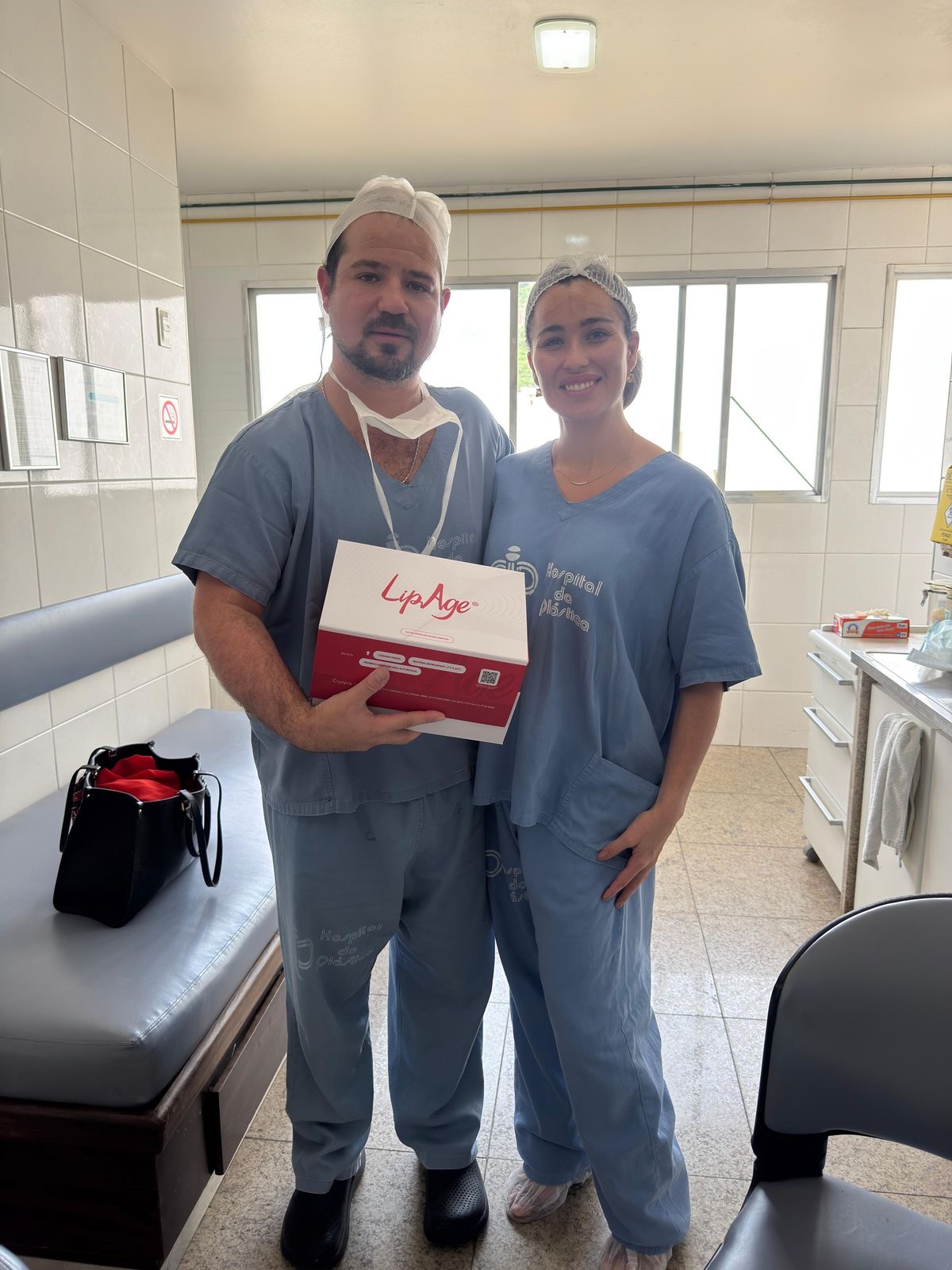
Surgeon Dr. Carolina M. Cruz is part of the medical team of LipAge, an autologous adipose tissue cryopreservation programme, alongside Dr. Vinícius Iglesias. In a hospital setting, the team presented the LipAge collection kit, designed so that adipose material obtained during liposuction — which would otherwise be discarded — can be collected aseptically and sent to Cryopraxis for processing, quality control and cryopreservation.
What the medical team does in practice
The technical workflow was designed to fit into the liposuction routine: collection is performed aseptically, the material is packed in the LipAge kit and travels through dedicated logistics. From there, Cryopraxis handles reception, processing, quality control, cryopreservation in liquid nitrogen and storage.
The involvement of physicians such as Dr. Carolina M. Cruz and Dr. Vinícius Iglesias is what connects cryopreservation technology to real surgical practice: without a team trained in aseptic collection, the biological material would not reach the laboratory in suitable condition.
What stage is this evidence at?
Cryopreservation of cells and tissues is an established technique in several areas of medicine. Future applications of cryopreserved adipose tissue — such as new fat grafts or uses in regenerative medicine — are at different stages of scientific evidence, and many remain investigational.
This is the distinction Fronteira Regenerativa considers essential: preserving the material is a technical reality today; each future clinical application will depend on its own studies, ethics approvals and specific regulatory registrations.
Why it matters
- Liposuction is one of the most frequently performed surgical procedures in Brazil, and the adipose tissue collected is rich in cells studied by regenerative medicine.
- Cryopreservation allows this material to be stored for the patient's own future use (autologous use), within current regulatory limits.
- Dedicated medical teams, such as the one working with LipAge, are the link between surgery and preservation science.
This article is informative and editorial. It is not medical advice, a treatment recommendation or a promise of results. Photograph: LipAge medical team — Dr. Vinícius Iglesias and Dr. Carolina M. Cruz present the collection kit in a hospital setting. Reproduced with permission.